game · Unity · C# · 2025
Crimson Sanctum
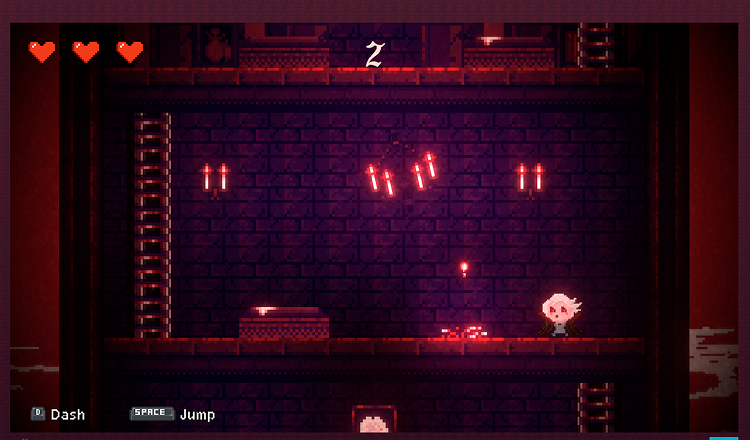
A 2D arcade-style endless-tower platformer with an auto-moving character. Time your dashes, line up your climbs, and see how far you can ascend.
Case study · STAR
The story
Situation
Crimson Sanctum is a 2D arcade-style platformer with an endless tower concept. The character moves automatically, so the player focuses on precise timing, positioning, and dash usage. The design challenge was that auto-movement removes a lot of player agency, and the controls had to feel responsive and fair without giving full directional control.
- Endless-tower platformer, auto-moving character
- Player agency limited to timing, dashes, and positioning
- Performance had to stay stable across long runs
Task
As Gameplay Programmer, I owned the player controller, the auto-movement direction logic, climbing transitions, dash and jump mechanics, and the floor spawn system that supports the endless tower without leaking memory.
- Player controller and movement state machine
- Direction handling when transitioning to climbing
- Dash, jump, and climb mechanics
- Endless floor spawn with object pooling
Action
I built the player controller around a state machine so walking, dashing, jumping, and climbing could be integrated without state conflicts. The trickiest part was making horizontal-to-vertical transitions feel natural, which I solved by separating movement logic by surface context and tuning state priorities. For the tower, I used Unity's object pooling so floors could be spawned and recycled dynamically as the player ascended, avoiding the cost of repeated instantiation. I also set up the post-processing stack and wrote an outline effect using Shader Graph for the game's atmosphere.
- State-based player controller covering walk, dash, jump, and climb
- Movement logic separated by surface context for natural transitions
- Object pooling on floors to keep performance stable on long runs
- Post-processing stack and Shader Graph outline effect
Result
The gameplay system runs smoothly and stays in line with the design intent. The player controller feels responsive even though it is auto-movement based. Dash and climb add mechanical depth without breaking the rhythm. The pooled floor spawn system holds performance across extended sessions.
- Stable performance during long endless-tower runs
- Controller feels responsive in spite of auto-movement
- Dash and climb provide the difficulty curve the design wanted
- Role
- Gameplay Programmer
- Patterns
- State Machine · Object Pooling
- Polish
- Post-process · Shader Graph
Tech notes
- Player controller built on a state machine to prevent conflicting transitions
- Object pooling drives the endless floor spawn without GC pressure
- Outline effect written in Shader Graph, paired with the post-processing stack